


Reducing fume cupboard energy costs (VAV & airflow) guide
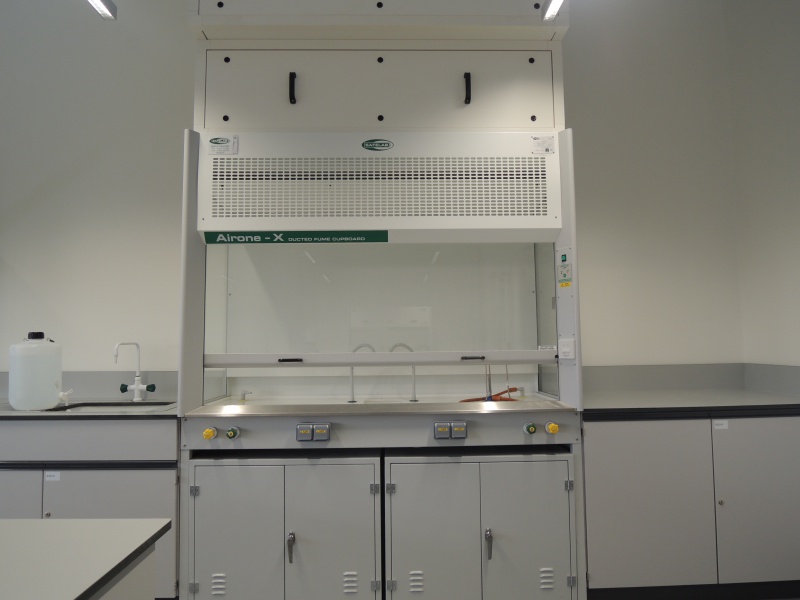
Fume cupboards are one of the largest and most overlooked energy consumers in a laboratory.
They operate continuously, move significant volumes of air, and have a direct impact on heating, cooling, and ventilation systems across the entire building. In many cases, a single fume cupboard can cost thousands of pounds per year to run when energy use is fully accounted for.
For schools, universities, research facilities, and commercial laboratories, this creates a growing challenge. Energy prices have increased, sustainability targets are becoming more demanding, and facilities teams are under pressure to reduce operational costs without compromising safety.
That balance is not always straightforward.
Reducing energy consumption is not simply about turning systems down or limiting use. Fume cupboards are safety-critical devices. Any changes must maintain containment performance and compliance with UK guidance.
The key lies in understanding how airflow works, how systems are controlled, and how design decisions influence long-term performance.
This is where concepts such as Variable Air Volume (VAV), sash management, and airflow optimisation become essential.
This guide explains how fume cupboards use energy, how VAV systems improve efficiency, and what organisations should consider when reviewing or specifying systems in the UK.
Quick answer: How can fume cupboard energy costs be reduced?
Fume cupboard energy consumption can be reduced by combining system design, control strategies, and user behaviour.
In practical terms, that means:
- reducing airflow when full extraction is not required
- using Variable Air Volume (VAV) systems instead of constant airflow
- managing sash position to limit unnecessary extraction
- ensuring cupboards are correctly specified for their application
- reviewing older systems that may be inefficient
The most effective improvements come from a coordinated approach, rather than a single upgrade.
In this guide
- Why fume cupboards use so much energy
- How airflow drives energy consumption
- What VAV systems are and how they work
- VAV vs constant air volume systems
- The impact of sash position and user behaviour
- Practical ways to reduce energy costs
- When to upgrade or replace a system
- How to specify an energy-efficient fume cupboard
Why do fume cupboards use so much energy?
To understand how to reduce energy use, it helps to look at where the energy is actually going.
Fume cupboards do not just consume electricity through fans or controls. Their main impact comes from air movement.
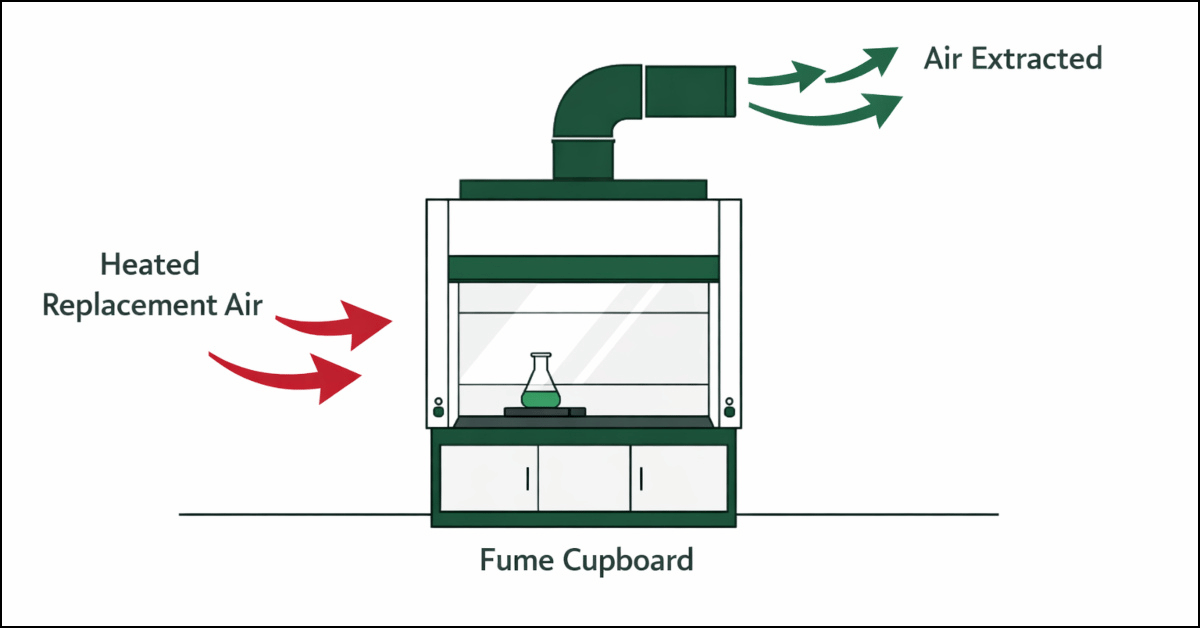
A ducted fume cupboard extracts air from the laboratory and discharges it outside the building. That air has already been heated or cooled as part of the building’s environmental control.
Once it is removed, it must be replaced.
Replacement air must be:
- heated during colder months
- cooled during warmer periods
- distributed through the ventilation system
This creates a continuous demand on the building’s HVAC system.
In many laboratories, fume cupboards operate for long periods, often throughout the working day and sometimes beyond. Even when not actively in use, older systems may continue extracting at full volume.
This is where inefficiency builds up.
A constant airflow system does not distinguish between:
- active work
- idle time
- open or closed sash
It simply continues running.
The role of airflow in energy consumption
Airflow is the single biggest factor influencing energy use.
The higher the airflow:
- the greater the volume of conditioned air removed
- the greater the demand on heating and cooling systems
- the higher the operational cost
This relationship is direct and significant.
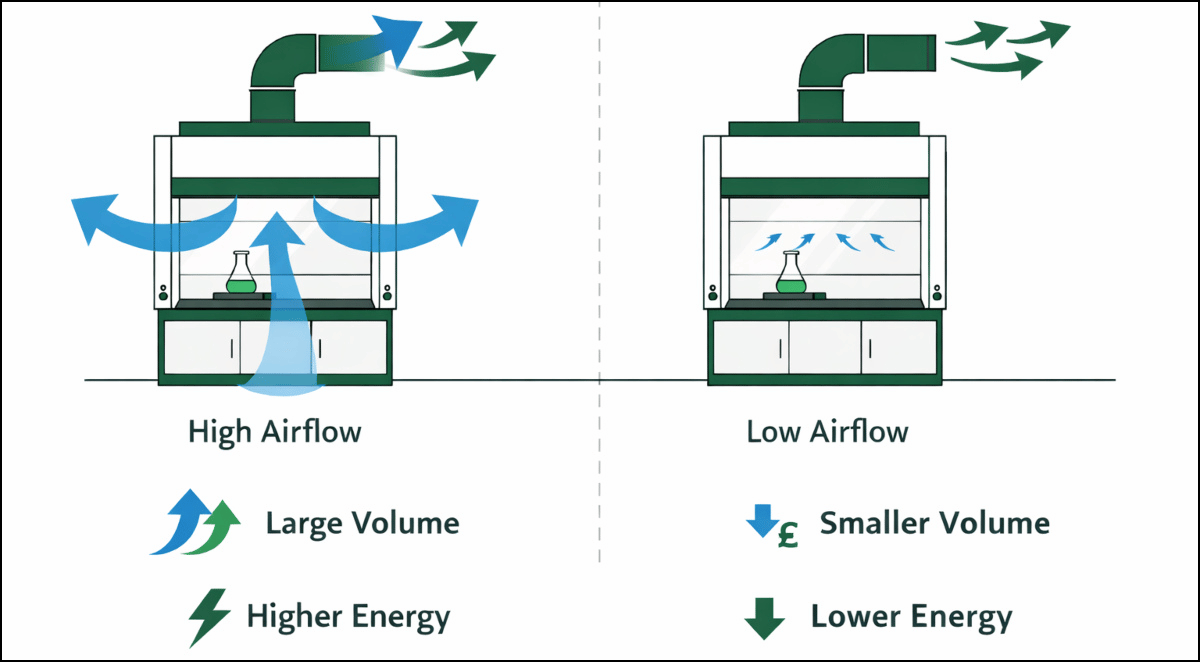
Reducing airflow, even slightly, can lead to measurable reductions in energy consumption across the entire building.
However, airflow cannot simply be reduced arbitrarily. It must still provide:
- effective containment
- safe face velocity
- reliable performance during use
This is where control systems become important.
What is a VAV fume cupboard system?
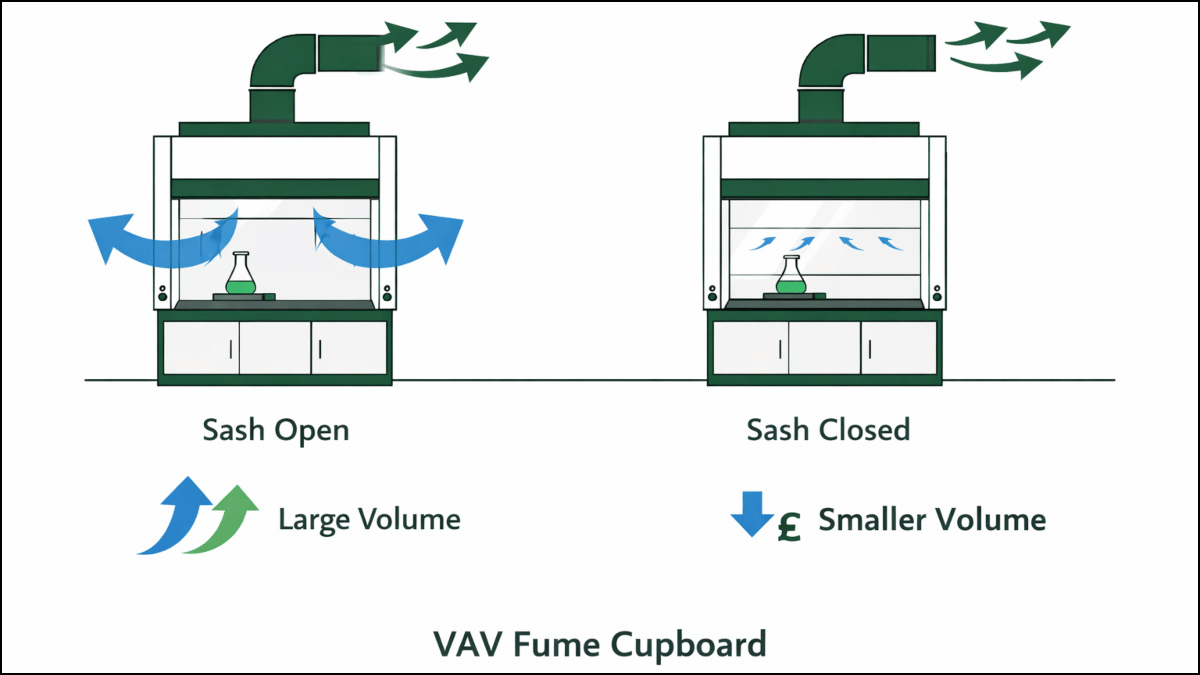
A Variable Air Volume (VAV) fume cupboard adjusts airflow in real time based on how the cupboard is being used.
Instead of operating at a fixed rate, a VAV system:
- reduces airflow when the sash is closed
- increases airflow when the sash is opened
- maintains safe operating conditions automatically
This allows the system to respond to actual demand rather than running continuously at maximum capacity.
For suitable projects, Safelab’s Airone XP4 can be specified as a VAV ducted fume cupboard to support responsive airflow control, reduced extract demand, and energy-conscious laboratory design.
From an energy perspective, this is a fundamental shift.
How VAV systems reduce energy costs
The principle behind VAV is simple but powerful.
When airflow is reduced:
- less air is extracted
- less replacement air is required
- heating and cooling loads decrease
Over time, this can lead to significant energy savings.
In many laboratories, cupboards are not in constant active use. Sashes may be left open unnecessarily, or systems may run at full volume even when idle.
A VAV system reduces this waste by aligning airflow with real conditions.
When combined with good user behaviour, such as closing sashes when not in use, the impact can be substantial.
VAV vs constant air volume (CAV) systems
Many older installations still use Constant Air Volume (CAV) systems.
These operate at a fixed airflow rate regardless of conditions.
CAV systems:
- simple and reliable
- predictable performance
- higher energy consumption
VAV systems:
- dynamic airflow control
- improved efficiency
- more complex but more responsive
For new installations and refurbishments, VAV is often considered where energy efficiency is a priority.
However, it is not always a straightforward upgrade. Integration with building systems, control strategies, and user behaviour all play a role in how effective the system will be.
How sash position affects energy use
Sash position has a direct impact on airflow and therefore energy consumption.
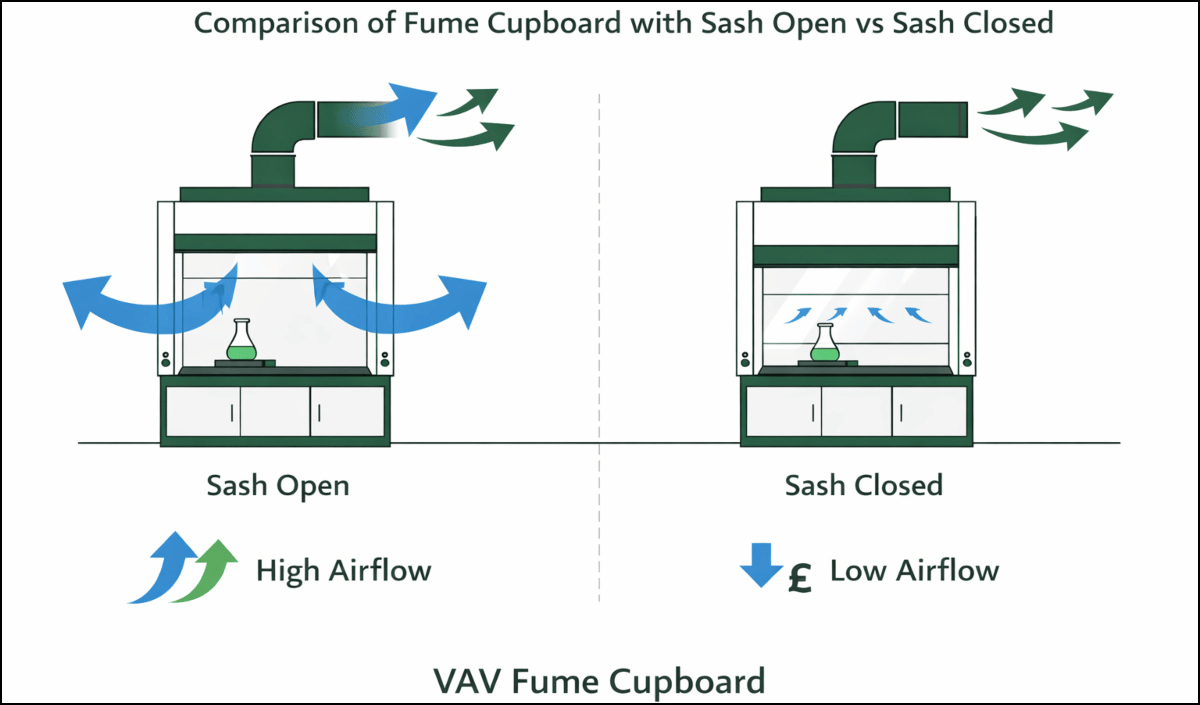
When the sash is open:
- airflow increases
- extraction volume increases
- energy demand increases
When the sash is closed:
- airflow reduces
- less conditioned air is removed
- energy use decreases
This relationship is particularly important in VAV systems, where airflow is directly linked to sash position.
In practice, this means user behaviour matters.
Even the most efficient system can perform poorly if sashes are left open unnecessarily.
This is why many laboratories introduce:
- sash management policies
- user training
- automatic sash closing systems
These measures are often low-cost but highly effective.
Practical ways to reduce fume cupboard energy costs
Improving efficiency is rarely about one single change. It is about identifying where energy is being used and making targeted improvements.
Upgrade to VAV systems where appropriate
For older constant volume systems, upgrading to VAV can deliver the largest energy savings.
However, this should be assessed alongside building systems and usage patterns.
Improve sash management
Encouraging users to close sashes when not in use can reduce airflow significantly.
Simple signage and training can make a noticeable difference.
Review existing cupboard performance
Older cupboards may:
- operate at higher airflow than necessary
- lack modern controls
- no longer match the application
A review can identify opportunities for improvement.
Optimise overall ventilation design
The fume cupboard is part of a wider system.
Room airflow, supply air, and HVAC design all influence performance and energy use.
Consider replacement rather than like-for-like upgrades
When refurbishing, it is worth reassessing the specification rather than replacing existing systems with similar ones.
Modern systems are often more efficient by design.
Before replacing an existing unit, our guide to fume cupboard installation requirements in the UK explains the ductwork, services, airflow, and commissioning factors that should be reviewed.
Safelab works with organisations to review existing installations and identify opportunities to improve both performance and efficiency, particularly where older systems are still in use.
When should you upgrade or replace a fume cupboard?
Many facilities continue to operate systems that were installed years ago, often under different assumptions about energy use.
It may be time to review your system if:
- energy costs are higher than expected
- the system runs continuously at full airflow
- controls are outdated or limited
- the cupboard no longer suits how the lab is used
Upgrading or replacing a system can improve:
- energy efficiency
- usability
- compliance
Energy-efficient fume cupboards in practice
Modern fume cupboards are designed with efficiency in mind.
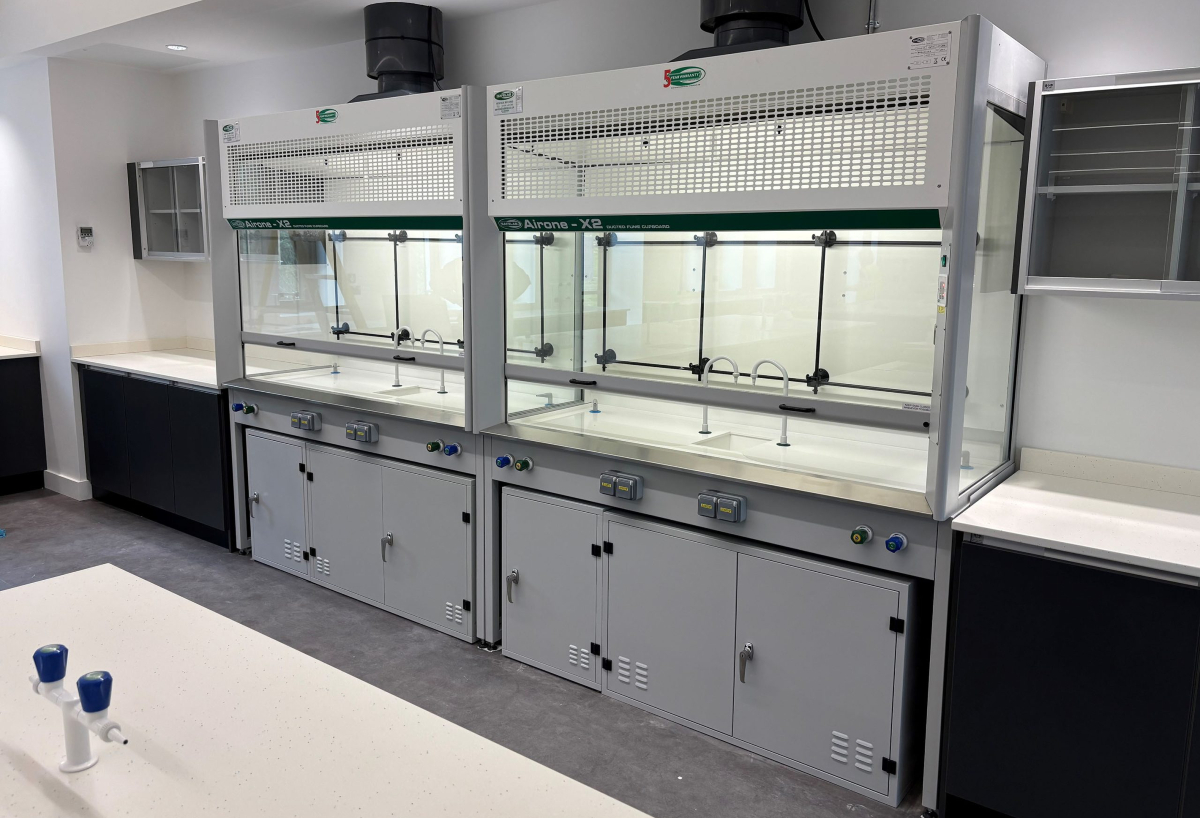
This can include:
- improved aerodynamic design
- better containment at lower airflow
- integration with VAV systems
- smarter control strategies
The aim is to achieve safe performance while reducing the amount of air that needs to be moved.
Safelab systems are designed with this balance in mind, particularly in environments where both safety and long-term operating cost are important considerations.
Specifying an energy-efficient system
Specification plays a critical role in long-term performance.
Safelab’s fume cupboard design and manufacture capability can help align cupboard selection, airflow strategy, controls, and building services from the start of a project.
Key considerations include:
Airflow strategy
Is VAV appropriate, or is constant volume sufficient?
Control systems
How is airflow monitored and adjusted?
Integration
Does the cupboard work with the wider building systems?
Usability
Will users operate the system correctly in practice?
Lifecycle cost
What are the long-term energy implications?
For a broader view of budgeting, our guide to fume cupboard costs in the UK explains how purchase, installation, energy, and lifetime costs should be considered together.
VAV systems in schools and education
In schools, energy efficiency is often balanced with simplicity and cost.
While not all school laboratories use VAV systems, they can be appropriate in:
- new builds
- larger facilities
- multi-cupboard environments
The decision should consider both:
- how the cupboard will be used
- long-term operating cost
 See also: Fume Cupboards for Schools: CLEAPSS G9 Compliance Guide
The wider impact: energy, cost, and sustainability
Reducing energy use has benefits beyond cost savings.
It contributes to:
- lower carbon emissions
- improved building performance
- alignment with sustainability targets
For many organisations, this is now part of a broader strategy rather than a standalone decision.
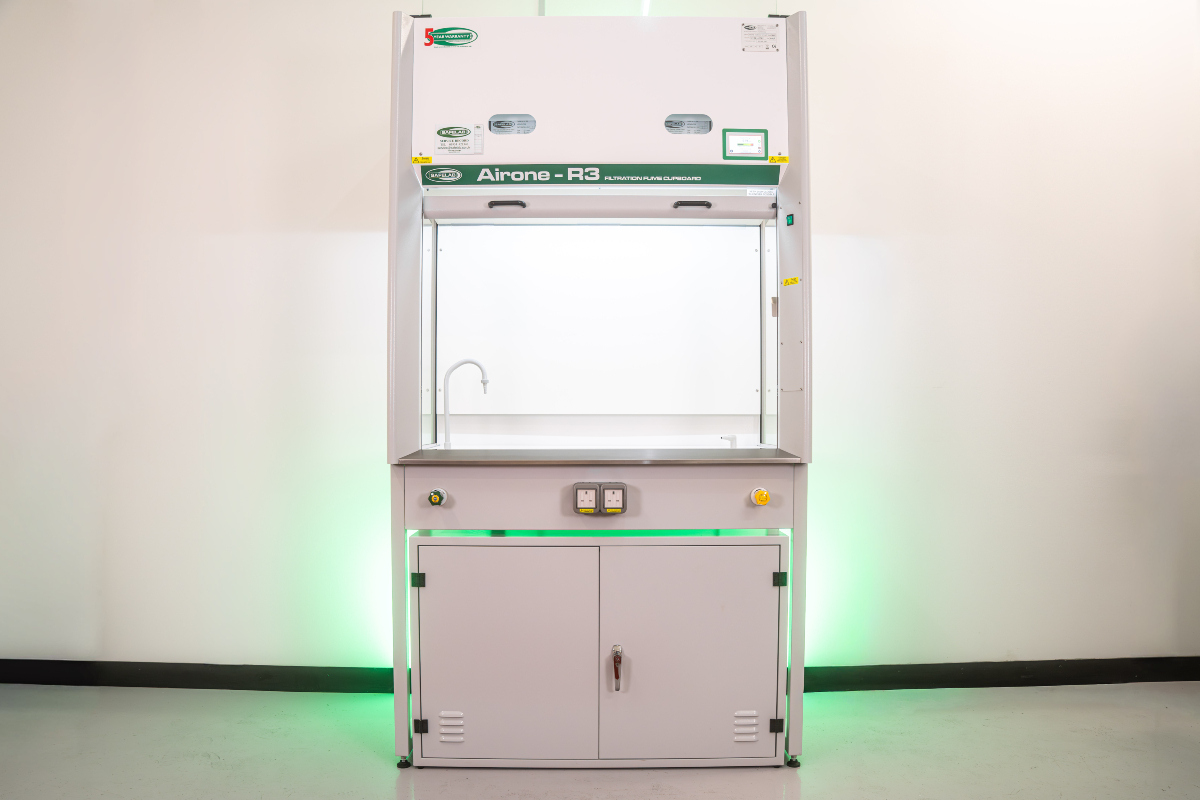
Need help reducing fume cupboard energy costs?
Improving efficiency starts with understanding how your current system is performing.
Safelab supports schools, laboratories, and organisations across the UK by:
- reviewing existing systems
- assessing airflow and energy performance
- advising on VAV and control strategies
- supporting specification and replacement
If you are looking to reduce energy costs or improve performance, it is worth starting with a practical review.
Frequently Asked Questions
How do I choose the right fume cupboard?
Start with the application — substances, processes, and usage — then assess room conditions and determine whether ducted or ductless containment is appropriate.
What is the difference between ducted and ductless fume cupboards?
Ducted systems remove contaminated air from the building. Ductless systems filter air and return it to the room.
Are ductless fume cupboards cheaper?
They can reduce installation costs in some cases, but lifecycle costs depend on maintenance, filter replacement, and suitability.
What should a fume cupboard specification include?
Application details, cupboard type, size, services, ventilation, controls, and testing requirements.
Do different sectors require different fume cupboards?
Yes. Requirements vary significantly between schools, universities, and industrial laboratories.